RHTP Signal Report · June 10, 2026
Two States, Two Playbooks
What Mississippi and Nevada just told the market about how RHTP will actually be executed over the next four years.
The Rural Health Transformation Program has been moving in slow motion since 2024 — states filing plans, CMS issuing guidance, consultants preparing proposals for procurements that had not yet been released. The second quarter of 2026 changed that. Award decisions are now landing, and the first two major ones reveal something important: there is no single RHTP playbook. States are making fundamentally different choices about how to structure their transformation efforts, which vendors they need, and in what sequence they intend to spend their allocated dollars.
Mississippi and Nevada are the clearest illustration of this divergence. Both are active RHTP states with real procurement activity. Both issued awards in the same two-week window in early June 2026. And yet they have almost nothing else in common in terms of strategy. Understanding why — and what each approach implies for the vendors, consultants, health systems, and community organizations that want to participate — is the purpose of this report.
Assessment-FirstMississippi
One Award That Shapes the Next Decade
On June 9, 2026, the Mississippi State Department of Health issued a Notice of Intent to Award for RFP RFx#3180002944 — Comprehensive State Health Plan. The award went to Premier Healthcare Solutions, Inc., which ranked first among seven responsive offerors evaluated by the state. The contract remains subject to approval by the Public Procurement Review Board before it becomes final, but a Notice of Intent to Award at this stage is rarely overturned; Premier is effectively Mississippi's RHTP planning partner.
What makes this award significant is not the specific vendor — it is what the contract is for. Mississippi is not buying implementation services, care coordination infrastructure, or workforce training. It is buying a map. The Comprehensive State Health Plan will define Mississippi's entire RHTP roadmap: which gaps exist across its rural health system, which stakeholders must be engaged and in what sequence, where federal reporting requirements create constraints on program design, and how the state's transformation strategy should be structured across the multi-year budget periods that follow.
This is the Assessment-First archetype. The state has chosen to invest its first significant RHTP dollars not in building anything, but in understanding what needs to be built, by whom, and in what order. It is a considered, low-risk approach for a state entering a program of this complexity for the first time. It is also an approach that concentrates a great deal of structural power in the hands of a single vendor at a very early stage.
How Mississippi Evaluated Offerors
Mississippi's scoring criteria for this procurement are revealing in their priorities. Rural experience was weighted most heavily — at roughly 35 percent of the total score — reflecting the state's need for a partner that has actually worked in geographies like its own, not one that is applying generic health systems consulting methodology for the first time in a rural context. Sustainability planning came second at approximately 30 percent, a signal that the state's long-term concern is not whether a transformation plan can be written but whether it can survive past the federal funding window. CMS reporting alignment (25 percent) reflects the compliance burden that comes with any federally-funded program at this scale. Community partnership documentation (10 percent) was the least-weighted criterion, though its presence on the scorecard indicates the state expects the planning process to be participatory, not just analytical.
| Criterion | Weight |
|---|---|
| Rural experience documentation | ~35% |
| Post-grant sustainability plans | ~30% |
| CMS reporting alignment | ~25% |
| Community partnerships | ~10% |
The vendor that designs a state's transformation roadmap gains embedded knowledge of every gap, stakeholder relationship, and political constraint in that system. That knowledge does not transfer to a second vendor. Assessment contracts are, in practice, a multi-year positioning exercise.
The structural consequence of the Assessment-First model is that the planning contract winner becomes the default incumbent for everything that follows. Not because the state necessarily intends this, but because the plan itself will be written with the planner's methodology, vocabulary, and vendor relationships embedded in it. When the next RFP is released — for transformation services, for care coordination infrastructure, for workforce programs — the winning vendor's proposal will naturally align with the planning framework they themselves produced. Competing vendors will need to argue against a roadmap written by someone else. This is a significant structural advantage, and it is one that accrues exclusively to Premier Healthcare Solutions in Mississippi for the foreseeable future.
For vendors that did not win the Mississippi planning contract, the more productive question is which comparable states are still open. New Hampshire and Montana are both Assessment-First states by archetype that have not yet awarded their initial planning procurements. The window in those states exists today. It may not exist in six months.
Infrastructure InvestorsNevada
24 Grants, 12 Counties, One Budget Period
Nevada took the opposite approach. Rather than concentrating its early RHTP investment in a single planning partner, the Nevada Health Authority used the Flex Fund mechanism in Budget Period 1 to distribute capital directly to 24 rural institutions across more than 12 counties. The awards span a remarkably wide range of investment types: imaging equipment for critical access hospitals, telehealth infrastructure for frontier communities, mobile behavioral health services, new rural clinic buildouts, retinal imaging for tribal health programs, and EMS equipment for volunteer fire departments.
This is the Infrastructure Investors archetype. Nevada's implicit theory of change is that transformation cannot happen until the physical and technical substrate exists to support it. You cannot coordinate care across a region if hospitals lack diagnostic equipment. You cannot deliver telehealth services if the endpoint — the patient-facing device or kiosk — does not exist in the community. By funding the physical layer first, Nevada is building the conditions under which service-layer transformation becomes possible in Budget Period 2 and beyond.
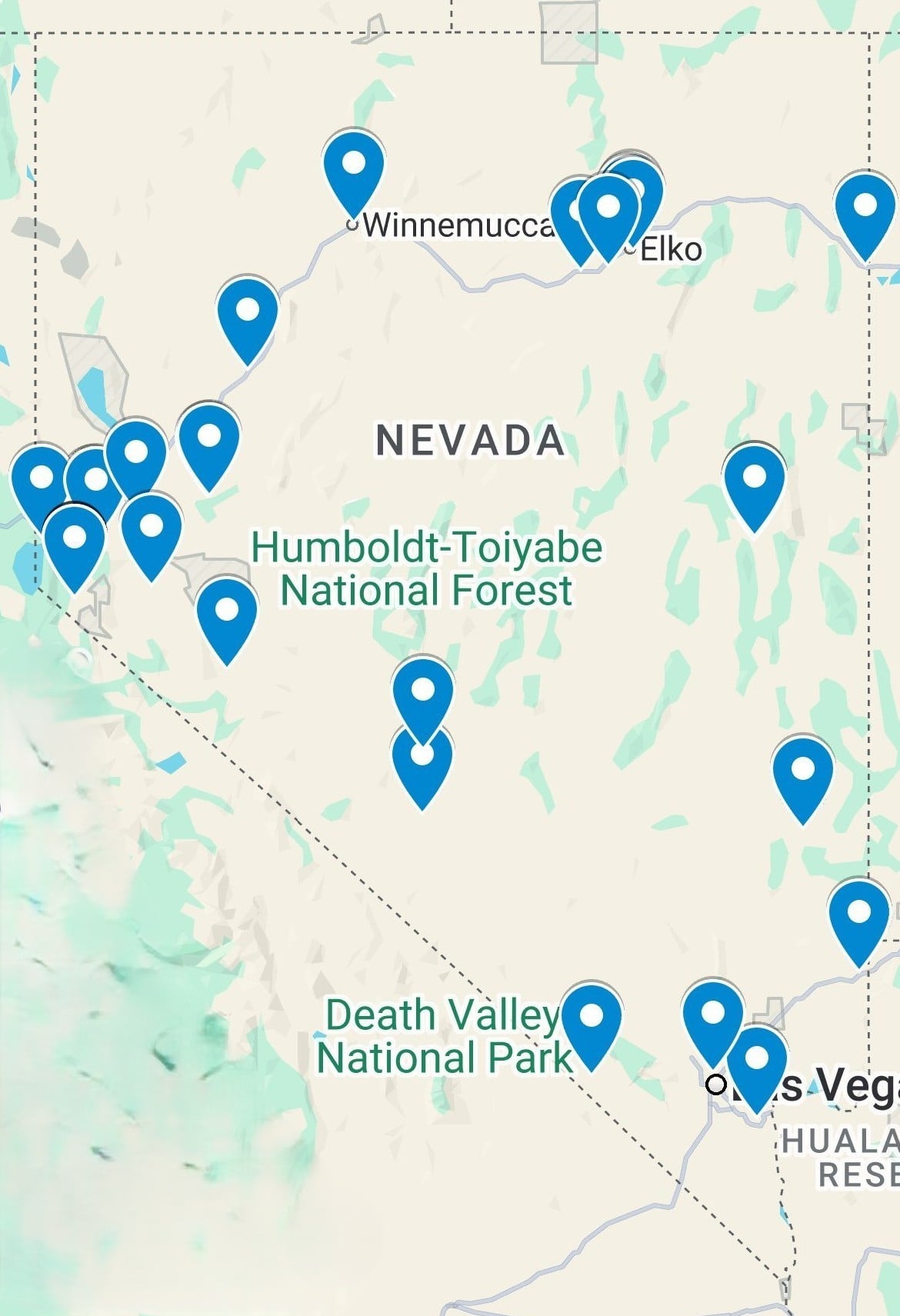
Selected Budget Period 1 Recipients
| Recipient | County | Investment |
|---|---|---|
| Banner Churchill Community Hospital | Churchill & Lyon | CT scanner + digital mammography upgrade |
| Silver Springs Stagecoach Hospital District | Lyon | Telehealth pod deployment + dialysis clinic infrastructure |
| Hope Christian Health Center | Nye | Mobile clinic with integrated telehealth |
| Esmeralda County Clinics | Esmeralda & Mineral | Three new rural clinic buildouts |
| Fallon Paiute-Shoshone Tribe | Churchill | Retinal imaging equipment for tribal health program |
| Vitality Unlimited | Multi-county | Mobile behavioral health unit + ACT services expansion |
| Carlin Volunteer Fire Dept. | Elko | EMS equipment and training infrastructure |
| + 17 additional rural hospitals, community health centers, and EMS organizations — full list available on the Nevada Flex Fund opportunity page | ||
The geographic distribution of these grants is intentional. Nevada's rural counties are among the most sparsely populated in the United States — Churchill, Nye, Esmeralda, Mineral, and Elko counties together cover an area comparable to several northeastern states, with populations measured in the tens of thousands rather than millions. The state cannot execute a centralized transformation strategy in this geography. Distributed infrastructure investment is not just a policy preference; it is a geographic necessity.
The involvement of tribal entities — specifically the Fallon Paiute-Shoshone Tribe — is also significant. Tribal health programs in Nevada have historically operated largely outside state-administered rural health infrastructure, often with separate federal funding streams and separate clinical networks. Their inclusion in the Flex Fund suggests Nevada is attempting to build a more integrated rural health ecosystem that crosses jurisdictional lines, which would be a meaningful shift if sustained into Budget Period 2.
Nevada's 24 funded sites are not just award recipients — they are the ecosystem that Budget Period 2 will be designed to serve. Organizations offering care coordination, workforce development, data systems, and behavioral health services now have a warm prospect list of institutions with funded infrastructure and a mandate to use it.
The strategic logic for vendors is straightforward: Budget Period 2 will almost certainly shift Nevada's focus from physical infrastructure to the services and systems that run on top of it. Care coordination between newly equipped rural hospitals and primary care sites. Workforce development programs to staff the clinics that just received capital funding. Health information systems and data integration layers that allow the newly distributed infrastructure to function as a coherent network rather than 24 isolated facilities. These are the service categories most likely to dominate Nevada's next procurement cycle, and the vendors that have already built relationships with the funded institutions — or can demonstrate specific experience with the infrastructure types that were funded — will have a meaningful head start.
The Two Archetypes — and the Four Others
Mississippi and Nevada represent two ends of a spectrum that runs across all 50 states currently engaged with RHTP. At one end, states like Mississippi are choosing to invest in understanding before acting — commissioning comprehensive analyses, building stakeholder maps, and producing transformation roadmaps before any implementation dollars are spent. At the other end, states like Nevada are moving quickly to deploy capital directly to institutions, accepting that some coordination inefficiency is an acceptable trade-off for speed and broad community engagement.
But these two archetypes do not exhaust the variation. Four additional patterns are visible across the broader RHTP landscape:
Community Navigator
States that are investing heavily in community health worker programs, rural extension services, and patient navigation infrastructure before building clinical capacity. The theory is that trust and access barriers are more limiting than facility capacity in their specific rural contexts.
Direct Service
States using RHTP funding to directly expand clinical service delivery — mobile clinics, expanded primary care hours, telehealth programs — without first commissioning a comprehensive assessment or building distributed infrastructure. These states typically have a specific, well-understood service gap they are trying to close.
Coalition Builder
States that are funding multi-stakeholder consortia — typically combining hospitals, FQHCs, public health agencies, and behavioral health organizations — to develop integrated transformation plans collectively. The initial investment is in governance and coordination infrastructure rather than clinical or physical infrastructure.
Workforce Builder
States that have concluded their most binding constraint is not funding or facilities but clinical workforce. RHTP dollars in these states are flowing predominantly toward rural training programs, loan repayment expansions, residency and fellowship placement in rural communities, and workforce pipeline development with rural-origin high school and college students.
In practice, most states blend elements of more than one archetype. A state might commission a planning assessment while simultaneously funding community navigator positions, or invest in infrastructure while running a parallel workforce development initiative. The archetype framework is useful not because it perfectly categorizes every state but because it focuses the right strategic question: given what this state is trying to do first, what type of vendor or partner is positioned to win early procurement and build from there?
Mississippi vs. Nevada — Side by Side
| Dimension | Mississippi | Nevada |
|---|---|---|
| Archetype | Assessment-First | Infrastructure Investors |
| BP1 approach | Single comprehensive planning contract | 24 distributed capital grants |
| Primary vendor type needed | Health systems consultants, policy analysts | Equipment vendors, telehealth platforms, clinic builders |
| Decision structure | Centralized — MSDH as single decision-maker | Distributed — 24 funded sites as independent decision-makers |
| BP2 implication | Transformation RFPs shaped by the BP1 plan | Service-layer RFPs to support funded infrastructure |
| Incumbent advantage | Very high — planner shapes all downstream RFPs | Moderate — relationship-based, per-institution |
| Comparable states still open | New Hampshire, Montana | Wyoming, South Dakota, Alaska |
What to Watch in the Next 90 Days
The Mississippi NOIA is subject to PPRB review before the contract is executed. Once that approval is in place and the planning work begins, the key marker to watch is when MSDH releases the first implementation-phase solicitations. Based on the assessment contract timeline and the state's published RHTP milestones, the first transformation RFPs in Mississippi are most likely to appear in late 2026 or early 2027. Vendors that want to compete should be building state-specific relationships and building their knowledge of Mississippi's rural health landscape now, not when the RFP drops.
In Nevada, the 30 to 60 days following the BP1 awards represent a window of maximum opportunity for vendor relationship development. The 24 funded institutions now have capital and a mandate. Many of them — particularly the smaller rural hospitals and community health centers — will be in active discussions with potential technology and service partners as they plan how to deploy the funding. Budget Period 2 procurement, when it comes, will be shaped in part by those early conversations.
More broadly, the pattern established by Mississippi and Nevada in June 2026 is likely to repeat across other states over the next 12 to 18 months. States that have been deliberating about their RHTP approach now have two well-documented examples to reference. Some will see themselves in Mississippi and commission assessment-first planning contracts. Others will see themselves in Nevada and move directly to capital deployment through grant mechanisms. In both cases, the vendors and organizations that have positioned themselves clearly for one archetype or the other — rather than arriving with a generic pitch — will be better positioned to win.
Related Analysis
Funder Analysis
→What States Actually Want — Funder Intent Early June 2026
All six state archetypes, applicant eligibility patterns, evaluation scoring weights, and the assessment-to-transformation pipeline strategy across 268 active procurements.
Signal Report
→Market at Full Velocity — Signal Report Early June 2026
$3.1B in verified state-level RHTP procurement across 167 active bids. Market structure, top 15 opportunities with verified budgets, and 18-month signals.